
Mark W. Barker is the President of The Interlake Steamship Company, a family-owned Great Lakes shipping operation based in Middleburg Heights, Ohio. He is not a celebrity or entertainer, so you won't find a splashy net worth figure on the usual gossip sites. What you will find is a second-generation executive running a capital-intensive industrial business that has invested more than $100 million in fleet modernization and moves roughly 20 million tons of cargo annually.
Mark W Barker Net Worth: Identify the Right Person

Russell Cho
5 Jun 2026

Based on what's publicly known about his role, the company's scale, and the assets tied to his family's name, a reasonable estimate puts his personal net worth somewhere in the range of $10 million to $50 million, though the true figure is unverified because Interlake is a privately held company with no public disclosure obligations.
Which Mark W. Barker are we talking about?
This is the first question worth getting right. At least two distinct people named Mark W. Barker show up across public records. The most prominent for our purposes is the Interlake Steamship president, son of company chairman James R.
Barker. Wikipedia's entry on Interlake Steamship Company names James R. Barker as chairman and his son Mark W. Barker as president, and Interlake even named a 639-foot, 26,000-gross-ton bulk carrier after him, which makes identification pretty unambiguous.
Interlake’s vessel page for the M/V Mark W. Barker states the ship is named for Interlake President Mark W. Barker and frames him as a second-generation leader of the family-owned-operates fleet [M/V Mark W. Barker is named for Interlake President Mark W.
Barker](https://www. interlake-steamship. com/our-fleet/m-v-mark-w-barker/). The second record worth flagging is an Alabama state licensing database entry for a "MARK W BARKER", but without matching biographical details (location, employer, credentials), there's no reason to assume that's the same person.
Unless you're researching someone in Alabama's licensed trades, the Interlake executive is almost certainly the one you're looking for.
The Interlake Mark W. Barker holds a Marine Engineering degree from SUNY Maritime College and an MBA from Case Western Reserve University's Weatherhead School of Management. He also holds an Unlimited Third Assistant Engineer License, meaning he worked his way up technically before moving into executive management. That background is distinct enough to rule out most naming confusion.
What reliable sources actually say about his net worth
Bluntly: no credible source publishes a specific, verified net worth for Mark W. Barker. If you are looking specifically for Mark Belling net worth, be cautious, because many numbers online for private executives are unverified guesses rather than sourced figures Mark W. .
He is not a publicly traded company executive required to disclose compensation, and Interlake Steamship is privately held, so there are no SEC filings, proxy statements, or annual reports to mine. What reliable sources do confirm is his long-tenured executive role (president since April 27, 2007), his family's controlling interest in a major Great Lakes carrier, and the company's substantial capital investment track record.
The Federal Maritime Commission's reading room includes his name in Lake Carriers' Association materials from February 2024, confirming his continued industry presence. That's the paper trail: leadership credentials and industry footprint, not a dollar figure.
Any specific number you see quoted on third-party net worth aggregator sites should be treated as an educated guess, not a verified figure. The $10 million to $50 million range used here is derived from reasoning about his role, tenure, and the family business's known scale, not from any disclosed salary or asset filing.
How he likely built his wealth: the career path
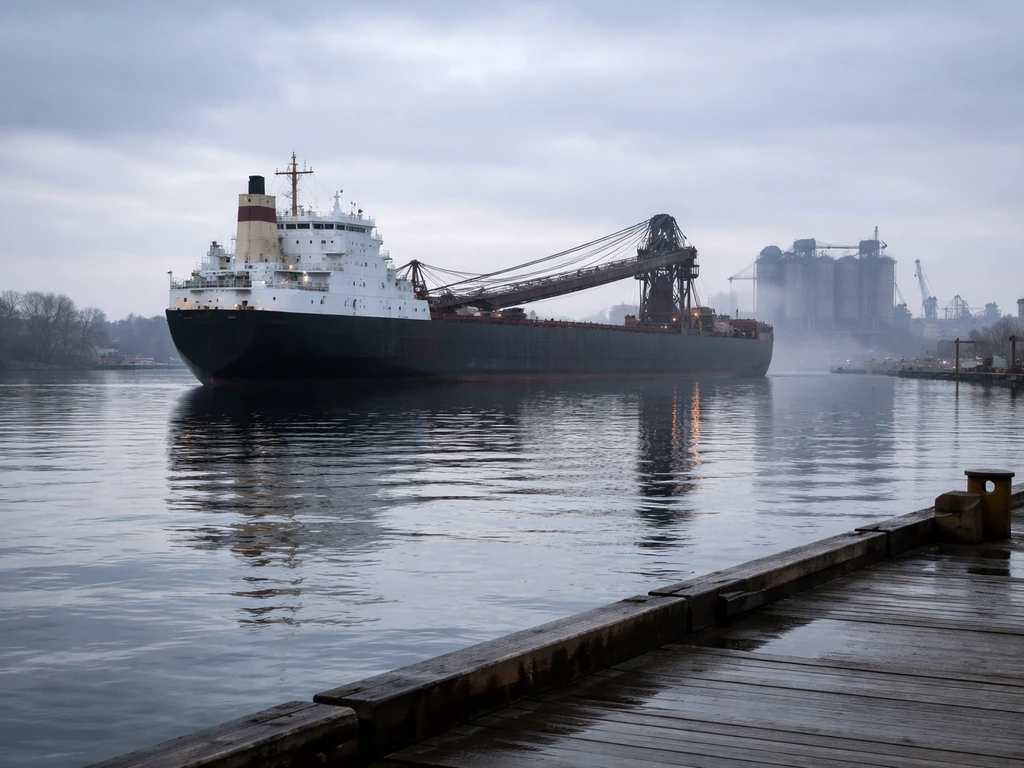
Mark W. Barker joined the family business in 1996, nearly a decade before becoming president. He didn't walk in as the boss's son and immediately take over. His progression ran from Fleet Engineer to Vice President and Treasurer before he was elevated to President in April 2007, succeeding his father James R. Barker. That trajectory matters financially because it suggests he accumulated compensation and likely equity stakes over a roughly 11-year climb inside a capital-intensive company. The engineering-to-executive path also means he understood the operational cost structure of running a fleet, which is the kind of knowledge that makes a difference when the company is deciding whether to sink $100 million into fleet modernization.
The Great Lakes bulk shipping industry is not glamorous, but it is economically significant. Interlake moves approximately 20 million tons of cargo per year, primarily iron ore, coal, limestone, and grain, which are the raw inputs for steel production and agriculture in the Midwest. As president of a company operating at that scale, Barker's compensation would realistically be in the range of a mid-to-large private company CEO: likely $500,000 to $2 million annually, though that's a reasoned estimate. Over nearly two decades in that role, the cumulative income alone would be substantial.
Income streams, assets, and debts: what feeds into the estimate
For a private-company executive like Barker, the wealth picture typically has several layers. Think of it in four buckets:
- Executive compensation: Annual salary and bonuses from his role as Interlake president, accumulated over nearly 20 years in that position and a prior decade in senior roles.
- Family business equity: As a second-generation leader of a family-owned company, he likely holds an ownership stake in Interlake Steamship or its holding entities. BIS Profiles lists a 'Mark W Barker' associated with Interlake Maritime Services, Inc., which suggests corporate entity involvement beyond just an employment relationship.
- Capital assets (indirect): While Interlake's ships are owned by the company, not personally by Barker, his equity stake in the company means the fleet's value contributes to his net worth indirectly. The MV Mark W. Barker alone, a newly built EPA Tier 4-class bulker launched around 2022, represents tens of millions in capital investment.
- Tax-deferred structures: The U.S. Maritime Administration's Capital Construction Fund (CCF) program allows U.S.-flag vessel operators to defer federal income taxes on deposits used for ship construction. This is a legal and commonly used structure in Great Lakes shipping, which can significantly affect the timing and effective rate of wealth accumulation for company owners.
- Personal investments and real estate: Typical for a long-tenured executive but entirely undisclosed publicly.
On the liability side, a family business running a capital-intensive fleet carries significant debt: vessel construction loans, maintenance costs, and operating credit lines. However, those are corporate liabilities, not personal ones, unless Barker has personally guaranteed any debt. There's no public evidence of personal financial distress or notable liabilities tied to him individually.
How his wealth has likely changed over time

| Period | Key Event | Likely Financial Impact |
|---|---|---|
| 1996-2006 | Joined Interlake; rose from Fleet Engineer to VP and Treasurer | Steady professional income; early equity accumulation in family business |
| 2007 | Elected President (April 27, 2007), succeeding father James R. Barker | Significant jump in compensation; increased ownership responsibility |
| 2007-2015 | Led company through post-2008 industrial downturn and recovery | Mixed: Great Lakes cargo volumes dipped then recovered; executive pay likely stable |
| 2015-2021 | Oversaw $100M+ fleet modernization program | Capital deployed into company assets; personal equity value tied to fleet appreciation |
| 2022 | MV Mark W. Barker launched as first new Great Lakes bulker since 1980s | Major capital milestone; new asset adds to fleet and company valuation |
| 2024-2026 | Vessel in active service; named in FMC/Lake Carriers' Association materials | Continued leadership; wealth estimate stable or growing with operational success |
The clearest wealth inflection point in the public record is 2007, when he became president, and the 2022 vessel launch, which signaled that the company made a major long-term capital bet during his leadership. Both events would typically correlate with increased equity value and compensation.
Why online estimates differ so much (and what red flags to watch)
If you've already Googled this and found wildly varying numbers, here's why: most net worth aggregator sites use algorithmic guesses based on job title, industry salary benchmarks, and sometimes confused identity matches. For a private-company executive named Mark Barker, those algorithms have very little actual data to work with. If you're specifically trying to pin down mark bish net worth from public sources, the same issue applies: most figures come from assumptions rather than verified disclosures. Some sites may conflate him with other people named Mark Barker entirely. Others apply a generic 'shipping company executive' salary multiplier and call it a day.
Red flags to watch for: any site claiming a precise figure like '$8.3 million' or '$47 million' without citing a source should be dismissed immediately. Precision without sourcing is a hallmark of fabricated data on these aggregator sites. Also watch for sites that describe Mark W. Barker's career incorrectly (wrong industry, wrong company, wrong location) as a sign they've confused him with someone else. The Alabama licensing record is a good example: a different Mark W. Barker in a completely unrelated field, and it would be easy for a low-quality aggregator to blend their data together.
How to verify and update the estimate yourself
If you want to do your own research and get closer to the truth, here's a practical checklist: You can also verify whether Mark W Barker appears in FEC filings by searching the Federal Election Commission databases for “Mark W Barker” and related organization names (if present) search FEC databases for "Mark W Barker".
- Check Ohio Secretary of State business filings: Search for Interlake Steamship Company, Interlake Maritime Services, and any related holding entities. Look for officer and registered agent listings that name Mark W. Barker, which can confirm his formal corporate roles beyond just his employment title.
- Search PACER (federal court records): A U.S. district court docket involving the M/V Mark W. Barker and Interlake Steamship (Faith Technologies Inc. v. Interlake Steamship Company, docket 1:2023cv00240) is publicly accessible. Court filings in maritime cases often contain asset valuations and financial disclosures.
- Search FEC databases: The Federal Election Commission's database is searchable by name and employer. If Barker has made federal campaign contributions, the record will show his employer and occupation, useful for corroborating his professional identity.
- Check MARAD vessel ownership records: The U.S. Maritime Administration maintains records on U.S.-flagged vessel ownership. Searching for Interlake Steamship or the MV Mark W. Barker will show documented ownership structures.
- Review Lake Carriers' Association materials: The FMC reading room document from February 2024 confirms Barker's industry affiliation. The Lake Carriers' Association website may list officers or board members, which can help identify his current active roles.
- Look for Ohio property records: County auditor records in Cuyahoga County or surrounding counties (where Middleburg Heights is located) are publicly searchable and can surface real estate holdings under his name.
- Cross-reference against industry salary benchmarks: The Bureau of Labor Statistics and private shipping industry surveys publish compensation ranges for top executives at companies of Interlake's size. That gives you a reasonable salary baseline to anchor any net worth estimate.
Putting it in perspective
Mark W. Barker sits in a category of wealth that's common but rarely discussed: the private family business executive who is genuinely wealthy by most standards but has no public profile that forces disclosure. He's not a celebrity entrepreneur making headlines, and he's not a Fortune 500 CEO with a proxy statement. He runs a company that moves millions of tons of industrial commodities across the Great Lakes every year, named a 639-foot ship after himself (or had it named for him), and has spent the better part of three decades building that business. That's a meaningful wealth story even without a verified number attached to it.
For context, other Marks covered on this site, such as those in media, sports, or entertainment, often have their wealth driven by public contracts, licensing deals, or equity exits that show up in court filings or press releases. The industrial shipping world works differently: wealth accumulates quietly through decades of operational leadership and family equity, with very little public disclosure. That makes verification harder, but it doesn't make the wealth any less real. The $10 million to $50 million range is a reasonable working estimate until better data surfaces. You can also see how the same reasoning is often summarized in searches for Mark Bittman net worth, but this article focuses on the Interlake executive.
FAQ
Why do so many websites list different Mark W. Barker net worth numbers? (and which should I trust?)
Assume any single dollar figure is a guess unless it ties to a disclosure source you can directly verify (for example, compensation reports for a public company, court filings, or a published ownership stake). For a privately held operator, most sites cannot legitimately convert job title into personal net worth with proof, so use ranges and require sourcing.
How can I confirm I am looking at the right Mark W. Barker and not a namesake?
In this case, the surest discriminator is career path and employer match. Look for the Interlake Steamship president profile (engineering degree plus MBA, progression through Fleet Engineer to executive roles, and leadership since 2007). If the profile matches a different location or industry, treat it as a different person, not an alternate valuation.
If there is no verified net worth statement, what method is most defensible for estimating it?
Because Interlake is private, personal net worth is not directly published. The closest approach is to triangulate from business scale (fleet size, cargo volumes, capital spending), then apply typical CEO compensation ranges and consider whether the family’s ownership likely includes equity that would compound over time. Even then, the output is still an estimate, not a verified figure.
What are the most common mistakes people make when reading net worth estimates for private executives?
Treat “precise” claims like “exactly $8.3 million” as a red flag if they do not name the underlying evidence. High-precision numbers without documentation often indicate scraped data plus a formula, not actual asset or liability information for the individual.
Can an estimated net worth for a private-company CEO be misleading even if the number sounds plausible?
Yes. A stated net worth might reflect corporate value or expected equity rather than personal liquidity. For example, if most value is tied up in private-company ownership, the personal net worth number can be high while cash available for spending or easy asset sale is much lower.
How should I think about debt for someone like Mark W. Barker, since shipping companies carry loans?
Look for any evidence of personal guarantees (bankruptcy filings, foreclosure notices, or court records tied to the person) rather than assuming debt is personal. In large shipping firms, most leverage sits at the company level, so assuming personal liabilities without proof can inflate or distort a net worth estimate.
Does Mark W. Barker’s career progression (technical roles to president) change how you estimate wealth?
The career timeline matters. If someone joined in a lower executive role and rose through engineering and finance leadership before becoming president in 2007, they likely built both compensation and long-term equity. That can justify a mid-to-long exposure to wealth building, but it still does not convert into a verifiable net worth number without ownership disclosure.
Should I estimate wealth from salary alone, or is equity a bigger factor for Mark W. Barker?
Yes, compensation-only logic can understate wealth, and equity-only logic can overstate liquidity. A better practical approach is to separate (1) estimated annual CEO pay during the presidency and (2) the probability of meaningful family-equity participation, then acknowledge that both are assumptions without a disclosed ownership schedule.
Why can’t I just convert Interlake’s size and investments into a direct net worth number?
Do not anchor on cargo volume or modernization spend alone. Those metrics describe company scale, which influences the likely compensation and value of an owners’ stake, but personal net worth also depends on family ownership percentage, any outside investments, and whether shares were diluted or transferred over time.
What quick self-check can I do before accepting a specific net worth figure for him?
You can do a safer “range check” by comparing typical compensation bands for private industrial CEOs plus duration in the role, then sanity-check whether a multi-million-dollar range is consistent with a likely ownership profile. If the claimed net worth is far outside the implied band (either extremely low or implausibly high), treat it as unreliable.
Next Article
Mark L Burns Net Worth 2026: Verified Range and Sources
Disambiguates Mark L. Burns, estimates net worth with verified-source range, explains income, assets, and how to validat